How chemotherapy works
- Chemotherapy medicines kill cells that are growing and dividing fast.
- Cancer cells grow fast, so chemotherapy kills them.
- But some normal cells in the body also grow fast: the bone marrow (which makes blood), hair roots, the lining of the mouth and gut, and the skin and nails. Chemotherapy affects them too, and this causes most side effects.
- Normal cells are good at repairing themselves; cancer cells are not. That is why chemotherapy is given in cycles: a treatment day, then a gap of 1 to 3 weeks for the normal cells to recover before the next dose.
- A few side effects are not about fast-growing cells, but about a particular medicine: for example tingling of the fingers, or effects on the heart, kidneys or hearing.
Where the side effects come from
Tap a number on the body, or a topic, to see what happens there.
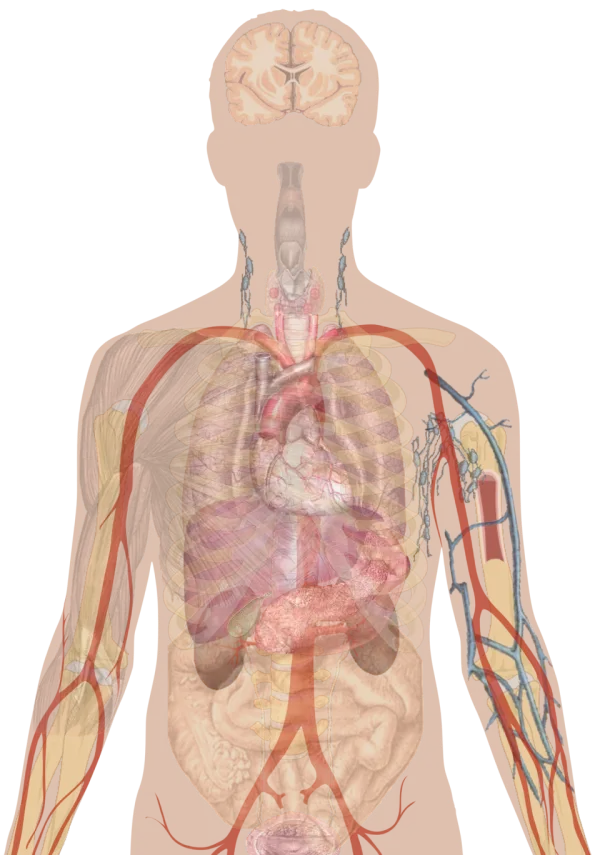
Body illustration: Mikael Häggström, public domain.
1. Bone marrow
- Makes white cells, red cells and platelets.
- Low white cells: risk of infection, lowest around days 7 to 14.
- Low red cells: tiredness, breathlessness. Low platelets: bleeding.
- Blood counts are checked before every cycle.
2. Hair roots
- Hair falls 2 to 3 weeks after the first cycle with some medicines, not all.
- It grows back after treatment.
3. Mouth
- Mouth sores and ulcers, around days 5 to 12.
- Salt water or soda bicarbonate rinses, and pain-relieving gels help.
4. Stomach and bowel
- Nausea and vomiting (well controlled with medicines given before and after).
- Loose stools or constipation.
5. Skin and nails
- Dry or darker skin, dark or brittle nails.
- Sore hands and feet with some medicines.
6. Nerves (some medicines)
- Tingling or numbness of fingers and toes with paclitaxel, docetaxel, oxaliplatin and others.
- Tell us early: the dose can be changed.
7. Heart, kidneys, ears (some medicines)
- Doxorubicin can affect the heart: an echo is done.
- Cisplatin can affect the kidneys and hearing: fluids and blood tests protect you.
Three kinds of side effects
This is how I explain side effects in clinic. Every side effect falls into one of these groups.
Settle on their own
They ease within days, usually before the next cycle.
- Nausea in the first few days
- Flu-like aches after some medicines
- Red urine after doxorubicin
Medicines help
We have medicines or simple measures to prevent or treat these. Tell us early.
- Vomiting: anti-sickness medicines
- Loose stools or constipation
- Mouth sores: mouthwashes
- Low white cells: growth factor injections
- Allergy during the drip: medicines beforehand
Need time to wear off
No medicine reverses these quickly. They improve slowly after treatment ends.
- Tiredness
- Hair loss (it grows back)
- Tingling of fingers and toes
- Change in taste
- Darker skin and nails
We check with tests
Uncommon but important. We look for them with blood tests or scans.
- Blood counts before every cycle
- Kidney and liver tests
- Heart scan (echo) with some medicines
- Hearing test with cisplatin
A typical 3-week cycle
Most chemotherapy is given every 2 or 3 weeks. Tap a row to see what to expect.
Days after the drip (day 1)
Treatment day
You come to day care. Blood tests are checked, then anti-sickness and other medicines are given before the chemotherapy. It takes a few hours. Most people go home the same day.
Nausea
Worst on days 2 and 3. Take the anti-sickness tablets on time for the first few days, even if you feel well.
Tiredness
Rest when you need to, but a short walk every day helps. Energy returns towards the end of the cycle.
Mouth sores
Rinse your mouth 4 to 6 times a day. Soft, mild food.
Low counts: infection risk
The most important window. White cells are at their lowest. Check your temperature if you feel unwell; 38°C or more is an emergency. Avoid crowds and people with infections; eat freshly cooked food.
Hair loss (some medicines)
Starts 2 to 3 weeks after the first cycle. It grows back after treatment.
Feeling better
Counts recover and energy returns. Blood tests are done just before the next cycle; if counts are still low, the next cycle may be delayed by a few days, which is safe.
How chemotherapy is given
- Drip (IV) in day care, over a few hours. Some regimens need a hospital stay.
- Tablets at home, such as capecitabine or temozolomide.
- A small pump you take home for 2 days (5-FU in FOLFOX and similar).
- A PICC line or chemo port (a thin tube into a large vein) protects your arm veins if you need many cycles.
- A course is usually 4 to 8 cycles, over 3 to 6 months. Scans are done in between to check that it is working.
Common questions
| Question | Answer |
|---|---|
| Does everyone lose their hair? | No. It depends on the medicine. Carboplatin, 5-FU, capecitabine and gemcitabine usually cause little hair loss. |
| Does everyone vomit? | Not any more. Modern anti-sickness medicines prevent vomiting in most people. |
| Can I eat normally? | Yes. Eat a normal, balanced, freshly cooked diet. There is no special diet that cures cancer, and fasting does not help. |
| Is it safe for my family to be near me? | Yes. You can hug and live normally. For 2 days after chemotherapy, flush the toilet twice and wash hands well, as traces are passed in urine. |
| Can I work? | Many people continue to work, with some days off around each cycle. |
Already on treatment?
Choose your regimen to see the side effects of your own medicines, when to expect them, and what helps.
How your treatment is decided
Every new patient's case is discussed at our multidisciplinary tumour board. This is a meeting where the medical oncologist, surgical oncologist, radiation oncologist, radiologist and pathologist, and when needed the nuclear medicine and palliative care teams, review your scans, biopsy and reports together.
- Cancer treatment often combines surgery, radiotherapy and medicines. The board agrees on the right treatments and the right order.
- You get one agreed plan, based on the latest evidence, instead of separate opinions.
- Cases are discussed again when the situation changes, for example after surgery or if a scan shows new findings.
Written and medically reviewed by Dr Prathyusha Eaga, MD, DM (Medical Oncology). Last reviewed: 12 October 2026. Based on NCCN and ESMO guidelines.
Have questions?
Book a hospital visit, a video consultation or a second opinion.